Izatt Christensen Lectureship
Christopher N. Bowman
Christopher N. Bowman is a Distinguished Professor of Chemical and Biological Engineering and Materials Science and Engineering at the University of Colorado Boulder, with joint appointments as a Clinical Professor of Restorative Dentistry. He holds the James M. & Catherine Patten Chair in Chemical Engineering and serves as Co-Director of the NSF Industry–University Cooperative Research Center (I/UCRC) for Fundamentals and Applications of Photopolymerizations.
Dr. Bowman is an internationally recognized leader in polymer science, photopolymerization reaction engineering, and advanced functional materials. His work has had a profound impact on polymer chemistry, biomaterials, dental materials, and micro- and nanotechnology, bridging fundamental science with industrial and clinical applications.
He is a member of the National Academy of Engineering and a Fellow of the National Academy of Medicine, and has received numerous honors for research, education, and innovation.
Selected Honors and Awards
- Member, National Academy of Engineering (2021)
- Fellow, National Academy of Medicine (2018)
- ACS Roy W. Tess Award in Coatings (2018)
- Fellow, National Academy of Inventors (2017)
- Mark Scholar Award, ACS Division of Polymer Chemistry (2017)
- AIChE Professional Progress Award (2011)
- AIChE Allan P. Colburn Award (2001)
- Alfred P. Sloan Research Fellow (1998)
- Materials Research Society Outstanding Young Investigator Award (1997)
- Camille Dreyfus Teacher-Scholar Award (1996)
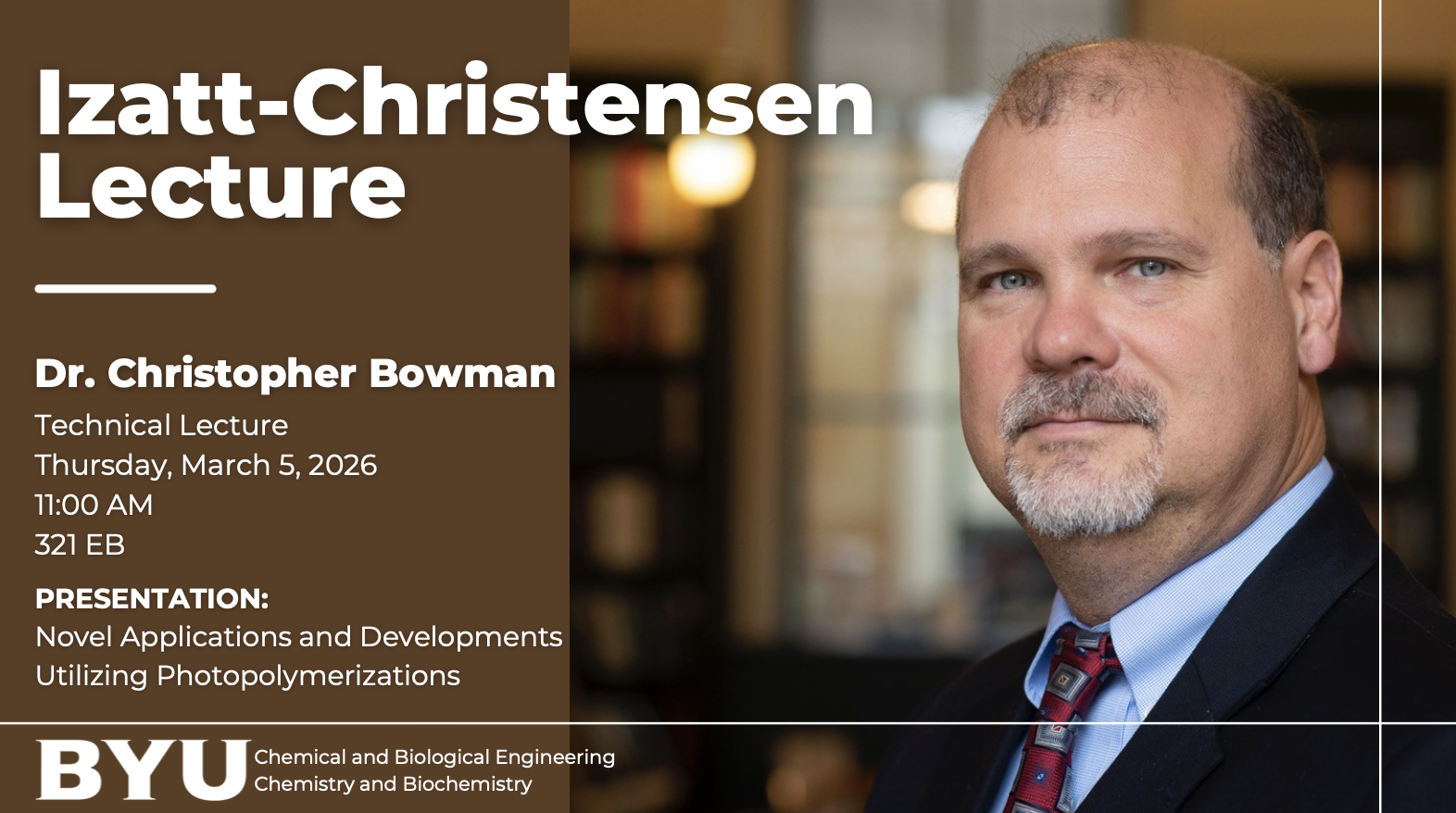
Technical Lecture: Novel Applications and Developments Utilizing Photopolymerizations
Time/Date: 11 AM, March 5, 2026 | Location: 321 EB
Abstract Photopolymerization reactions have been explored and utilized since the time of the ancient Egyptians; however, development of new photopolymerization methodologies and applications continues at an ever more rapid pace. Traditionally, photopolymerization of multifunctional monomers results in highly crosslinked materials suitable for applications such as optical lenses, optical fiber coatings, and dental materials. These reactions are ubiquitous not only because of the nature of the final polymer product, but also for the characteristics of the reaction itself. Photopolymerizations are far more energy efficient than their thermal counterparts, are typically performed in a solventless manner that is more environmentally compatible, the reactions occur rapidly at ambient conditions, and the polymerization can be controlled in both time and space. Here, we will focus on two distinct vignettes related to our photopolymerizations work including the development of novel click-reaction based photopolymerization reactions and materials and development of polymer networks with dynamic covalent links that exhibit unique responses to exposure to light that alleviate stress and lead to shape and compositional changes. First, we will discuss the potential and application of photopolymerization reactions based on click reactions. These unique polymerizations enable fabrication of low stress, highly functional, homogeneous materials with the facile ability to induce a multistage polymerization reaction suitable for the formation of holographic and other optical materials. We will next present work on covalent adaptable networks (CANs) that incorporate dynamic covalent bonds as crosslinks within the network that respond to light to (de)activate the dynamic bond character. These materials are able to change shape and stress-state when exposed to light, facilitating application as novel optical and actuating materials.
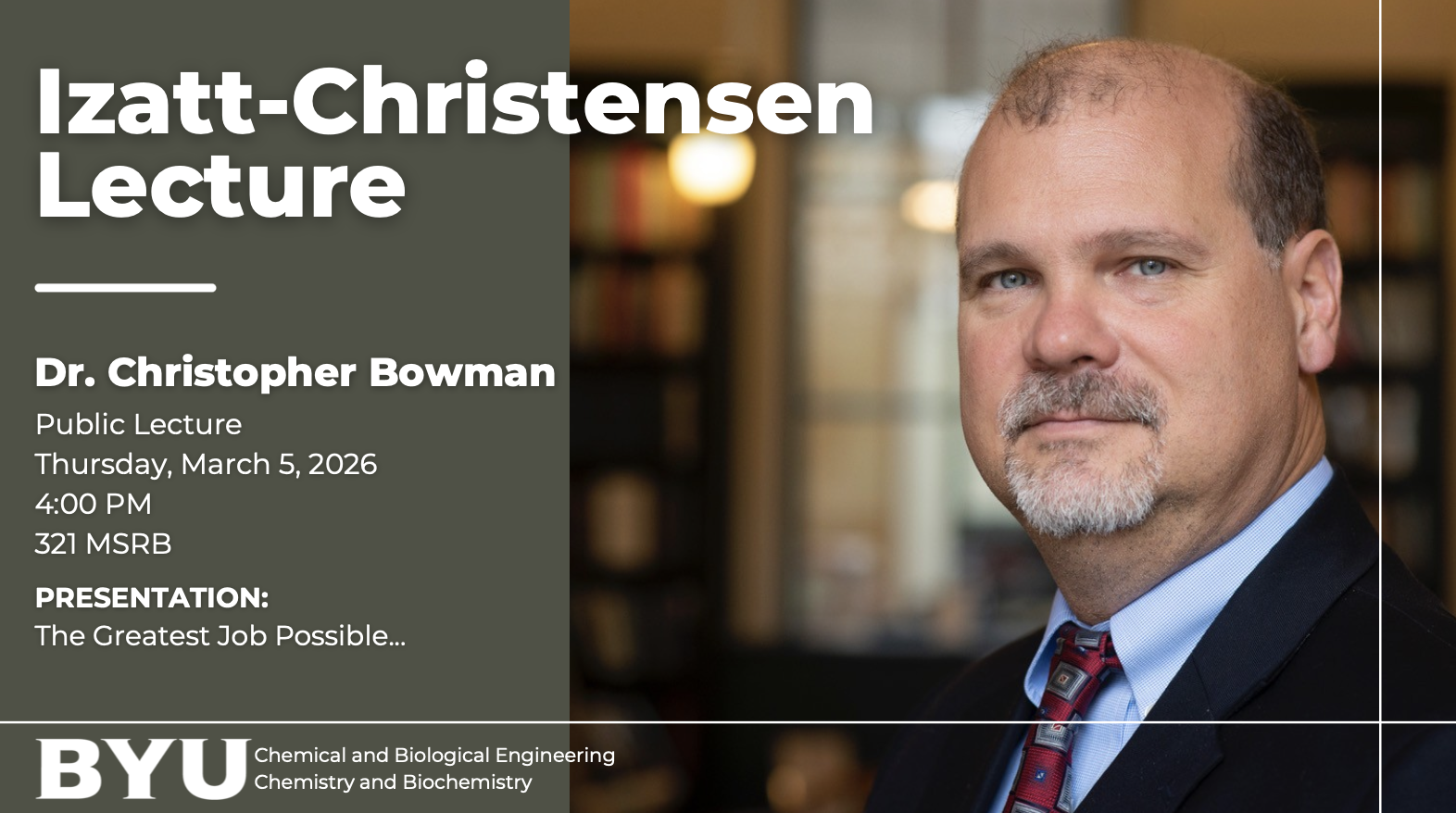
Public Lecture: “The Greatest Job Possible…”
Time/Date: 4 PM, March 5, 2026 | Location: 321 MSRB
Abstract Scientists, engineers and most other fields use their professional training to achieve significant individual and professional successes, with that being the primary goal for most people in their job. However, while technical aspects of our jobs, whether in a university or industry, bring great satisfaction and the potential for significant impact, a frequently neglected part of our professional opportunities relates to the potential we have to change people’s lives more directly through those we impact on a day-to-day basis. Here, I will share why I am firmly convinced that I have the greatest job possible, for me, with a chance to impact society in general through technological development and through the chance to help people achieve the goals they have for themselves. From a lot of failings and some successes, learnings will be shared about some ways to think about technological development and generate (good) ideas, and to help those around you professionally to move toward their own goals. Specifically, we will discuss topics associated with (i) where ideas come from with one example from my own program, (ii) ideas on better mentoring and being mentored, and (iii) some thoughts about best practices in education, both in the discovery/research setting and in the classroom setting.
Professor Christopher N. Bowman received his B.S. and Ph.D. in Chemical Engineering from Purdue University in 1988 and 1991, respectively. After receiving his Ph.D., he began his academic career at the University of Colorado in January of 1992 as an Assistant Professor. Since that time Professor Bowman has built a program focused on the fundamentals and applications of crosslinked polymers formed via photopolymerization reactions. He works in the broad areas of the fundamentals of polymerization reaction engineering, polymer chemistry, crosslinked polymers, photopolymerizations and biomaterials. Professor Bowman has remained at Colorado throughout his academic career and is currently the Patten Endowed Chair of the Department of Chemical and Biological Engineering as well as a Clinical Professor of Restorative Dentistry at the University of Colorado at Denver.
Visiting BYU
For a map of campus see map.byu.edu. Visitor parking can be identified by clicking Parking. Click Buildings to locate the Engineering Building (EB for Technical Lecture) and the MSRB (for the Public Lecture). It is not possible to park adjacent to the buildings where the lectures are held.
Izatt Christensen Award and Lectures
In 2007, Reid Izatt created an endowment at Brigham Young University to invite an eminent scientist or engineer from the worldwide community to present two lectures to the combined Departments of Chemistry and Biochemistry, and Chemical Engineering. The lectures include one more technical in nature for faculty and students and a second more universal in nature for the general public.
The Reed M. Izatt and James J. Christensen lecturers include:
- J. Fraser Stoddart (15–16 November 2007)
- Gabor A. Somorjai (21–22 January 2009)
- George M. Whitesides (3–4 November 2009)
- Robert Byron Bird (17–18 November 2010)
- Richard N. Zare (7–8 February 2012)
- Robert Langer (6–7 February 2013)
- Mario Capecchi (23–24 January 2014)
- Alexis T. Bell (19 March 2015)
- R. Graham Cooks (20–21 March 2017)
- Franklin Orr (19–20 October 2017)
- Geraldine L. Richmond (26–27 February 2019)
- Thomas F. Edgar (19–20 February 2020)
- Juan J. de Pablo (16 February 2023)
- Frances Ligler (12–13 March 2024)
- Nicholas Peppas (13–14 March 2024)
- Glenn Fredrickson (6 February 2025)
- Christopher N. Bowman (5 March 2026)